Do Indian brands charge more for bigger sizes?
The size surcharge (paying more for a 6XL than a 4XL of the same garment) is one of the most-repeated complaints in plus-size retail. We had the per-size prices for 4,228 items, so we counted.
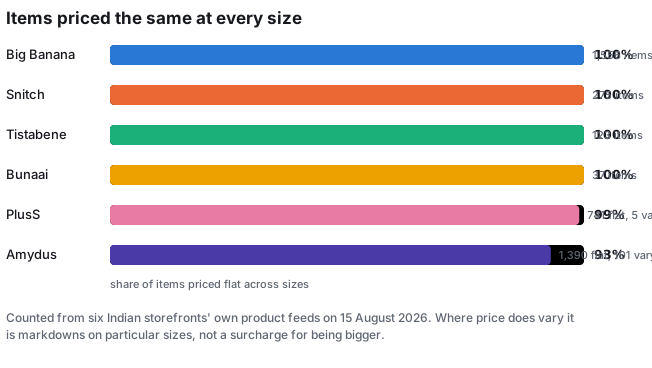
In short: across 4,228 items with more than one priced size, 97% cost exactly the same at 10XL as at 4XL. There is no size surcharge at the six Indian stores we checked, and where price does move it is a markdown, not a premium. Everyone who wears above a 4XL has had the thought at the checkout. The same shirt, more fabric, and a quiet suspicion that you are being charged for the privilege of being your size. People repeat it constantly, and we had the per-size prices sitting in a file, so we counted instead of arguing.
Four of the six stores showed no size-linked price variation at all. And where the price did move, the larger size was frequently the cheaper one, which is the opposite of what everybody expects.
That is a more encouraging answer than the category's reputation would lead you to expect, and we were mildly surprised by it, so here is the working.
 If you are here because a size did not fit rather than because of the price, that is a different problem with the same cause.
The data#
Read from the six storefronts' own public product feeds on 15 August 2026. For every product we took every size variant with a price attached, and compared the cheapest to the dearest.
| Store | Items priced flat across sizes | Items where price varies | Largest gap seen |
|---|---|---|---|
| Big Banana | 1,556 | 0 | - |
| Amydus | 1,390 | 101 | ₹2,300 |
| PlusS | 741 | 5 | ₹500 |
| Snitch | 275 | 0 | - |
| Tistabene | 123 | 0 | - |
| Bunaai | 37 | 0 | - |
| Total | 4,122 (97%) | 106 (3%) |
The 3% that isn't flat#
This is where it would be easy to write a headline and hard to be right, so: we looked at every one of the 106.
They are not surcharges. They are markdowns applied to particular size variants, and the direction is inconsistent with a size premium. Three real examples from the feed:
- A wrap dress at ₹1,299 in 4XL, 6XL, 7XL, 8XL and 9XL, and ₹999 in 5XL.
- A winter kurta at ₹4,499 in 4XL, 5XL, 6XL, 8XL and 9XL, and ₹2,699 in 7XL.
- Another at ₹4,499 in 4XL, 6XL and 9XL, ₹2,699 in 5XL, 7XL and 8XL.
If a brand were charging a size premium you would see a clean monotonic staircase: each size up costing a little more than the last. What is actually there is scatter: whichever sizes are overstocked get marked down, and quite often those are the deep ones. That is inventory management, and it works in the buyer's favour.
What this does and does not show#
It is worth being precise about the claim, because this is a topic where imprecision does real damage.
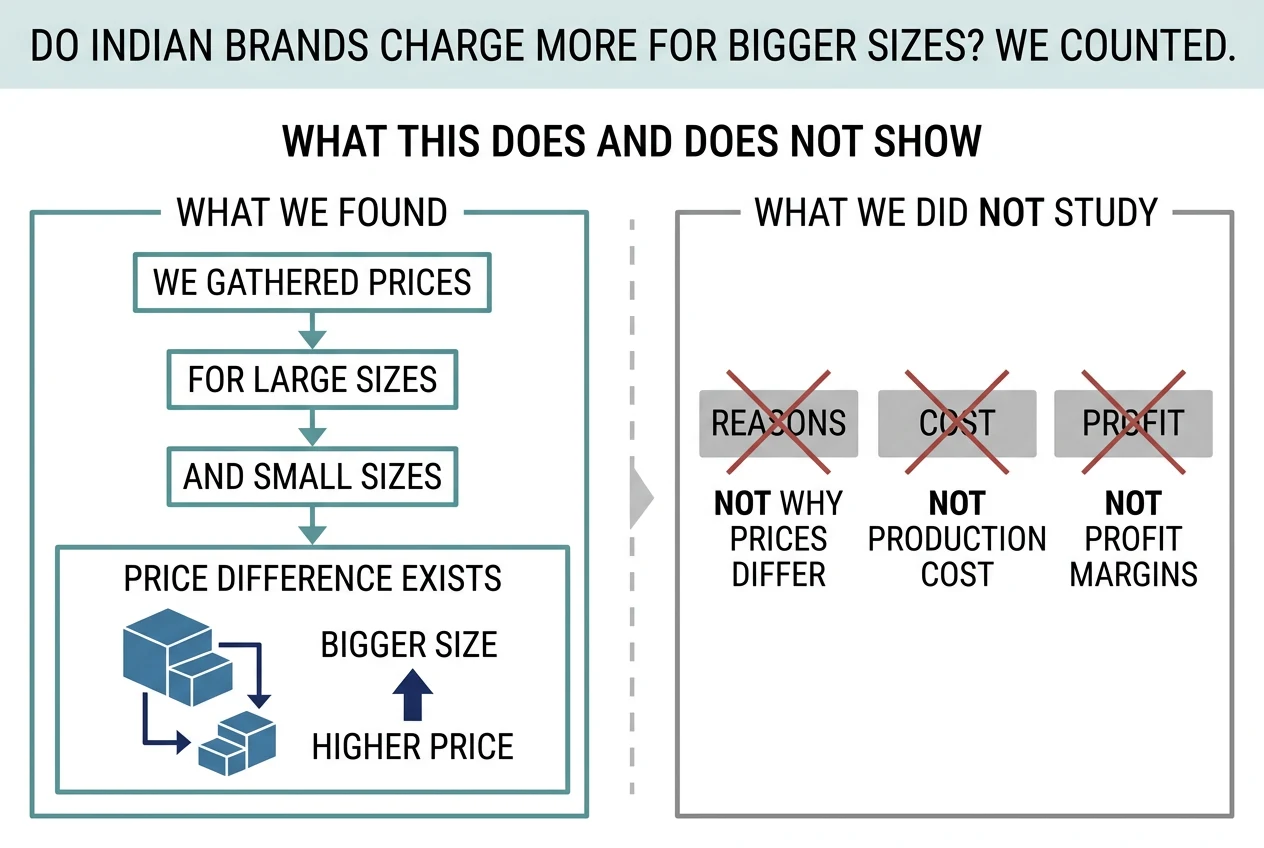
What it shows: the six online storefronts we list, which specialise in extended sizes, overwhelmingly price a garment the same regardless of which size you take. If you are shopping in this set, you are not paying more for being bigger.
What it does not show:
- Anything about mainstream brands that stop at XXL. A brand that will not sell you the size at all is a different problem, and a larger one.
- Anything about what a 6XL costs to make. More fabric is more fabric; a flat price means the brand is absorbing that, not that it doesn't exist.
- Anything about tailoring, offline retail, or made-to-measure, where the economics are completely different.
- Anything about the range available at each size, which is where the real inequity in this category sits. Price parity across a range that stops at 5XL is not much use at 7XL.
The inequity that the price data misses#
Here is what we think the more honest framing is.
Across these six stores there are 4,258 items at 4XL and above. By 7XL, two stores of six are still serving you. The cost of being at the top of the size range is not usually paid in rupees. It is paid in choice, and in the time it takes to find out that the thing you liked was never available in your size.
That is the reason we filter the shelf to your size before you ever see it. Not to be clever, but because the alternative (browsing a catalogue that will reject you at checkout) is the actual tax.
Check it yourself#
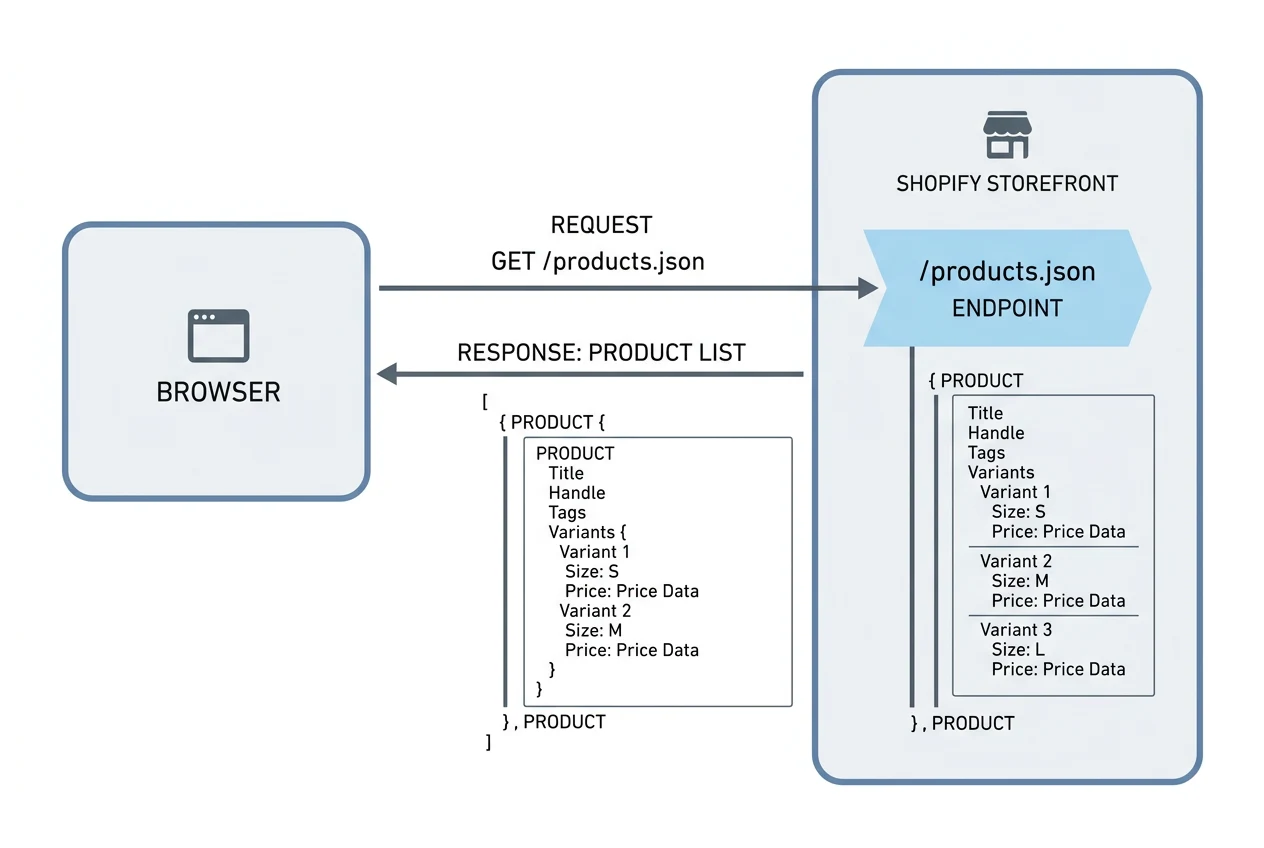
None of this is proprietary. Every store here runs on Shopify, and a Shopify storefront exposes its own catalogue at /products.json, per-variant prices included. You can pull the same numbers with a browser.
We re-read the feeds whenever we refresh the catalogue, and the date at the top of this page is the date this count was taken. Prices move; treat any figure here as of that day rather than as a permanent fact.
Questions people actually ask#
Do Indian brands charge more for larger sizes?
Mostly no, on this evidence. Across 4,228 items with more than one priced size, 97% carry the same price from their smallest to their deepest size. Four of the six stores we checked had no size-linked price variation at all.
What about the 3% where the price does vary?
In nearly every case it is a markdown on specific sizes rather than a surcharge on large ones. The discounted variant is often the bigger size. That is clearance behaviour, not a size premium.
So the size surcharge is a myth?
Not a myth, but not what we found here. This measures the shelf price of six online storefronts that specialise in extended sizes. It says nothing about mainstream brands that stop at XXL, about tailoring, or about what an item costs to make.
How can I check this myself?
Every number here comes from public Shopify product feeds: add /products.json to any Shopify storefront and you can read the per-variant prices yourself. The date matters: prices move.