What your size is, and what the garment actually measures
There is no enforced national standard for Indian clothing sizes. So a 6XL is whatever the brand that made it decided a 6XL is. Here is what the labels usually mean, what they mean at the brands we carry, and how to stop guessing.
In short: XXXL is usually drafted for a 46 to 48 inch chest, 4XL for 50 to 52, 5XL for 54 to 56 and 6XL for 58 to 60. Before you trust any chart, check whether it describes your body or the garment, because the two are never the same number. You have found a shirt you like. It comes in 4XL. Somewhere on the page there is a number, maybe 50, and no indication of whether that 50 is your chest or the shirt's. Getting that one thing wrong is the single most common way to order the wrong size.
Short answer: in India, XXXL (3XL) is usually drafted for a 46–48 inch chest, XXXXL (4XL) for 50–52 inches, 5XL for 54–56, 6XL for 58–60 and 7XL for 62–64. Those are body measurements, not garment measurements, and they are a convention rather than a rule. No Indian standard is enforced, so every brand is free to disagree, and most of them do.
That last sentence is the entire problem with buying clothes above 3XL, so the rest of this page is about working around it.
What the labels are supposed to mean#
The letter sizes are a convention that most Indian brands loosely follow. Written out, with the numeric equivalents you will see on the same garment:
| Label | Also written | Chest, men (in) | Bust, women (in) | Chest (cm) |
|---|---|---|---|---|
| XXL | 2XL | 44–46 | 42–44 | 112–117 |
| XXXL | 3XL | 46–48 | 44–46 | 117–122 |
| XXXXL | 4XL | 50–52 | 46–48 | 127–132 |
| XXXXXL | 5XL | 54–56 | 50–52 | 137–142 |
| 6XL | — | 58–60 | 54–56 | 147–152 |
| 7XL | — | 62–64 | 58–60 | 157–163 |
| 8XL | — | 66–68 | 62–64 | 168–173 |
| 9XL | — | 70–72 | 66–68 | 178–183 |
| 10XL | — | 74–76 | 70–72 | 188–193 |
Treat this as a starting point for narrowing down, not as an answer. XXXL in numbers has the letter-to-number conversion in full. It tells you roughly where a label sits. It does not tell you whether a specific shirt will fit you, and anyone presenting a table like this as definitive is overstating what it can do.
Body measurement versus garment measurement#
This is the distinction that causes most returns, and almost nobody spells it out.
- A body measurement describes you. Tape around the fullest part of your chest, level, not pulled tight.
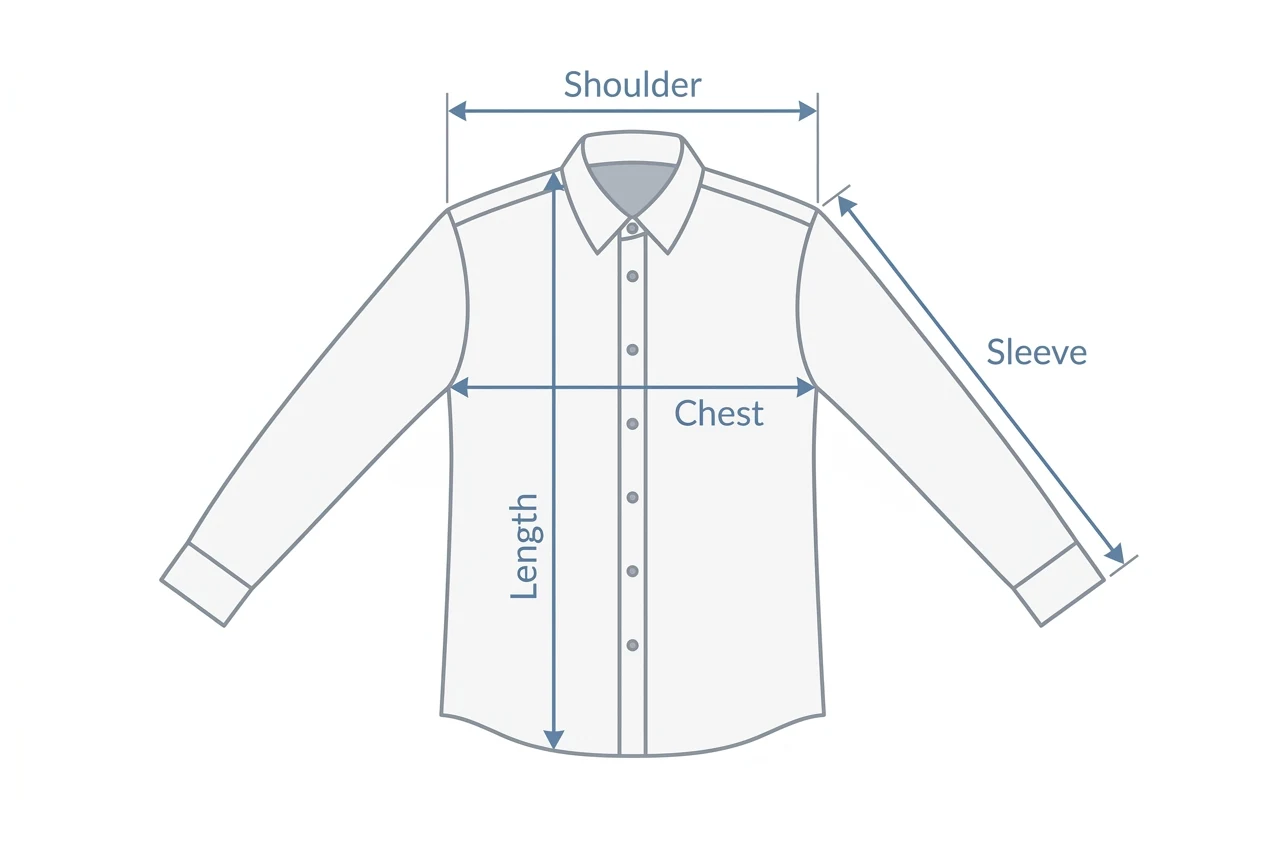
- A garment measurement describes the clothing. Lay the shirt flat, measure across the chest from seam to seam, double it.
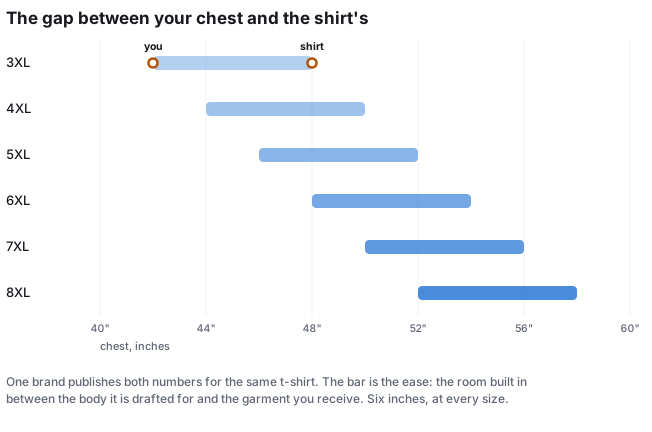
They are not the same number and they are never the same number. A shirt drafted for a 50 inch chest might measure 56 inches around, because it needs somewhere between 4 and 8 inches of ease to be wearable. On a t-shirt that gap is around 4 inches. On a formal shirt, 5. On a jacket, 7 or more. On jeans, barely 1.
So when a chart says 4XL = 50 inches, you have to know which one it means. If it is a body chart and your chest is 50 inches, that is your size. If it is a garment chart and your chest is 50 inches, that shirt will fit you like a second skin and you want to go up.
The tell: charts headed "to fit chest" or "body measurements" are body charts.
 Charts with columns for chest, length, shoulder, sleeve are almost always garment charts, because bodies do not have a "length".
The charts these brands actually publish#
We list six Indian stores. Seven of the brands we have checked do publish a chart covering extended sizes, but only four of those describe your body rather than the clothing, which is the distinction that decides whether the numbers are any use to you.
Amydus publishes a full body chart from 2XL to 9XL. These are their numbers, from their own size chart page, last checked 15 August 2026:
| Size | To fit bust | To fit waist | To fit hip |
|---|---|---|---|
| 2XL | 40" | 38"–40" | 46" |
| 3XL | 42" | 40"–42" | 48" |
| 4XL | 44" | 42"–44" | 50" |
| 5XL | 46" | 44"–46" | 52" |
| 6XL | 48" | 46"–48" | 54" |
| 7XL | 50" | 48"–50" | 56" |
| 8XL | 52" | 50"–52" | 58" |
| 9XL | 54" | 52"–54" | 60" |
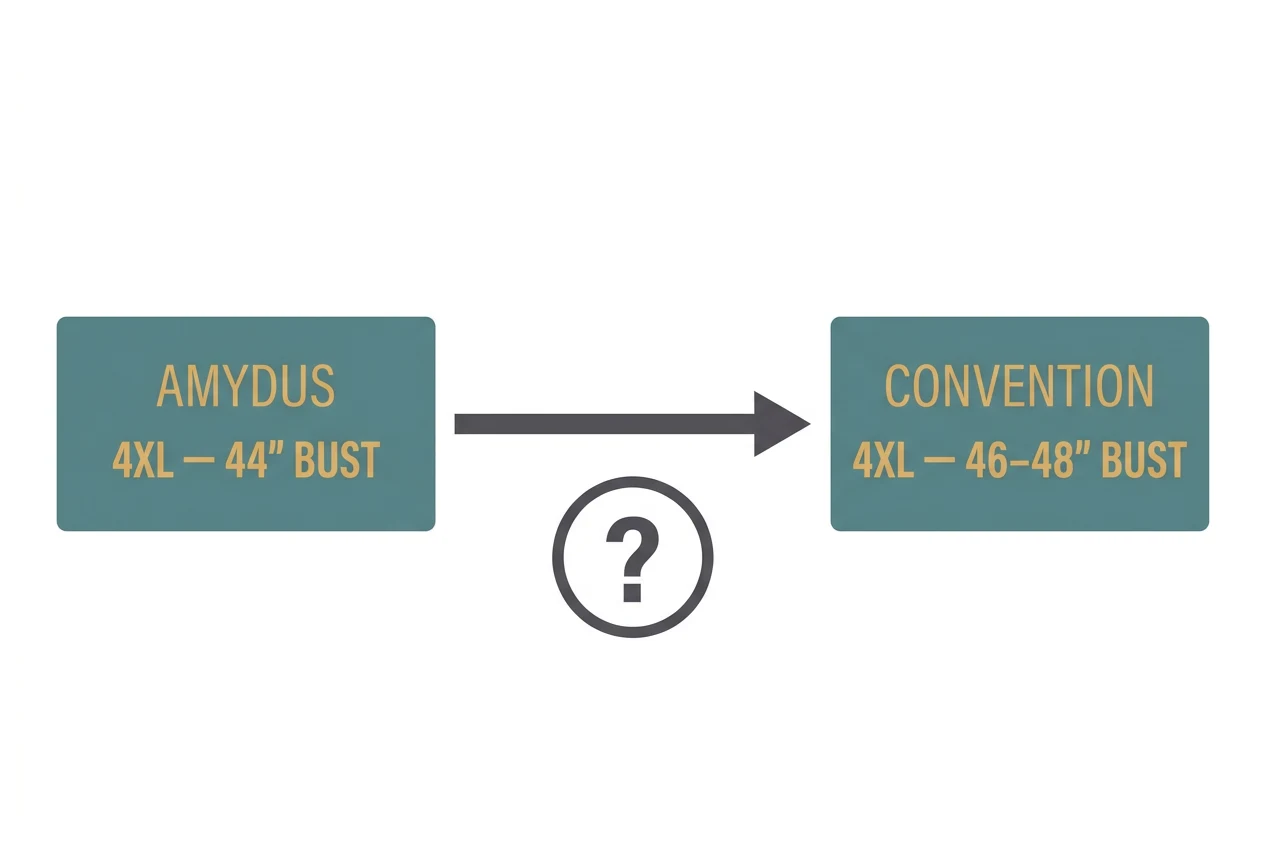
Look at that against the convention table above. Amydus drafts its 4XL for a 44 inch bust; the general convention for womenswear is 46–48. Their 4XL is close to what most of the market calls a 3XL, and their 9XL lands near a conventional 6XL.
Neither is wrong. It is their range and they are entitled to grade it how they like. And by publishing it they have done more than the other five put together. But if you wear a conventional 6XL and you order a 6XL from them expecting the same garment, you will be disappointed, and you will probably blame yourself rather than the label. Don't. The label moved, not you.
Bunaai publishes a body chart to 5XL, and Tijori publishes one that stops at XXXL.
Big Banana, PlusS, Snitch and Mufty publish charts too, but theirs are garment measurements: the shirt laid flat, not the person wearing it. Useful, but only if you know how much ease the brand builds in, and none of them publish that. Tistabene we have not found a chart for at all. Where a brand publishes nothing, we fall back on the convention table and say so on the product page rather than pretending to a precision we do not have.
Two Indian brands can print the same letter on garments eight inches apart, which is why this page leads with inches and not letters.
Why the same size differs at every brand#
Three reasons, in order of how much damage they do:
Nothing forces agreement. There is no enforced Indian sizing standard that a brand must grade to. A 6XL that measures like someone else's 4XL carries no penalty, so over time the labels drift apart rather than converge.
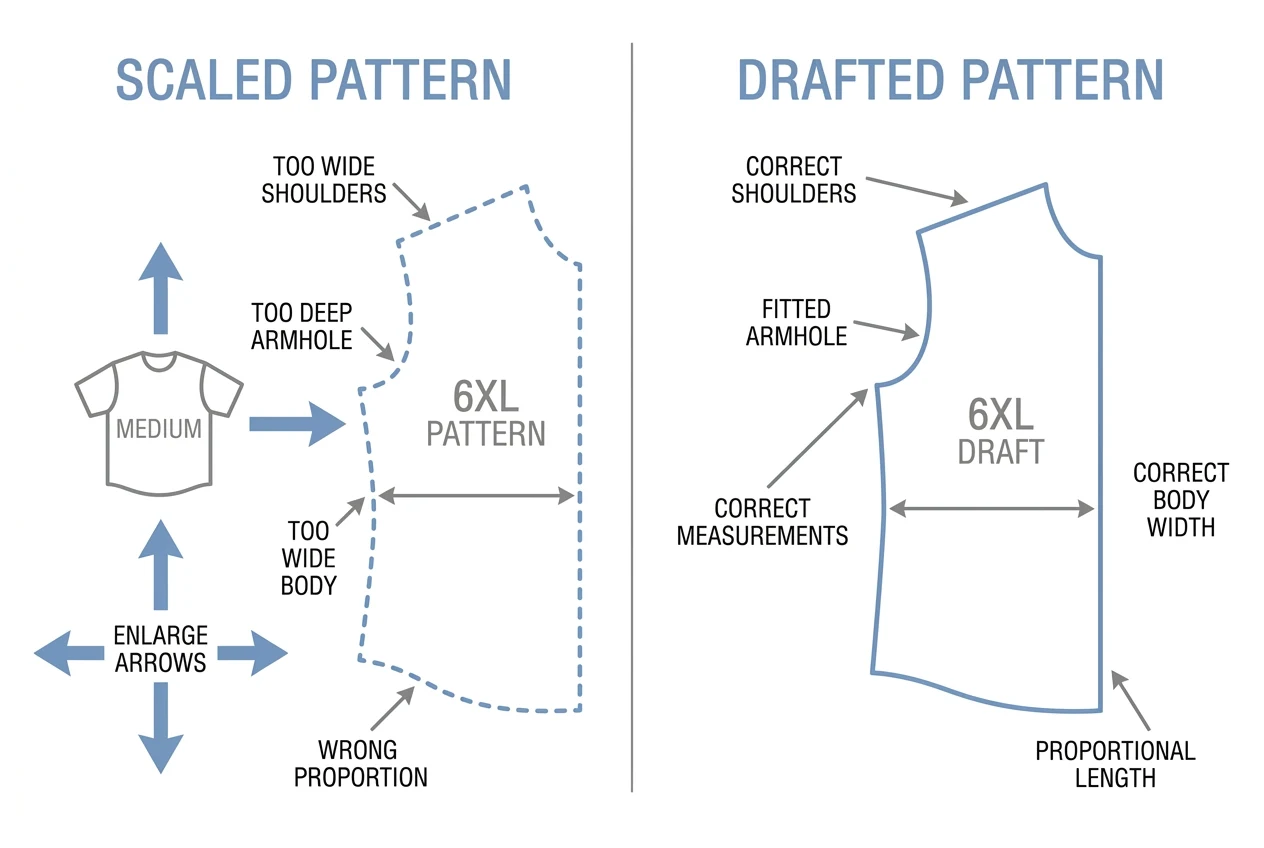
Most large sizes are scaled, not drafted. The cheap way to make a 6XL is to take the medium pattern and multiply it. That works for width and fails for everything else: depth through the body, the front rise on a trouser, the distance from shoulder to the fullest part of the chest. Bodies do not get proportionally larger in every direction at once, so a scaled 6XL tends to be wide enough and still wrong.
"Plus size" is a marketing word, not a measurement. Plenty of collections labelled plus size stop at XXL. The phrase describes who the brand is talking to, not what they will sell you.
How to measure yourself in ninety seconds#
You need a soft tape, a mirror, and a t-shirt on. Not shirtless: you will pull the tape too tight.
- Chest or bust. Around the fullest part, tape level all the way round, snug enough to stay up and loose enough to slide a finger under.
- Waist. Around your natural waist, which for most people above 3XL is the fullest part of the stomach rather than the narrowest point. Measure where you actually wear your trousers.
- Hip. Around the fullest part of the seat, feet together.
- Shoulder. From the bony point of one shoulder, across the back, to the other. Get someone else to do this one.
- Neck. Around the base, plus one finger. This is the number that decides whether a formal shirt is wearable, and hardly anyone publishes it.
Write them down. Chest alone will get you to the right size most of the time; chest plus neck will get you there for shirts. If you would rather not hold three numbers in your head against six different charts, the measurement board does that comparison for you and shows which brand's chart each answer came from.
How to measure a shirt you already own#
Faster and more reliable, if you have something that fits well. Lay it flat, buttoned, no stretching:
- Chest: armpit seam to armpit seam. Double it.
- Length: from the base of the collar straight down to the hem.
- Shoulder: seam to seam across the back.
- Sleeve: shoulder seam to cuff.
Now you have four garment measurements. Any brand publishing garment measurements can be compared to them directly, no conversion and no guessing about ease. This is the single most reliable way to buy above 4XL online, and it is why we ask for chest rather than size when we compute a fit verdict.
Neck and bicep: the two numbers nobody publishes#
For a formal shirt, chest is not the binding constraint. Neck is.
A collar that gaps looks careless and a collar that chokes is unwearable, and neither is fixed by sizing up the body of the shirt. You just end up in a tent with a tight collar. Above a 46 inch chest, neck girth and chest circumference stop tracking each other reliably, which is exactly when brands stop publishing neck sizes.
Bicep is the same story for anyone who carries weight on their arms. A 6XL shirt with a 5XL armhole is a common and infuriating combination.
If a brand publishes neck and bicep, that is a strong signal they drafted the range rather than scaled it. Ask for both. Most will not have them.
Sizes above 7XL#
The range thins out very fast past 7XL. Across the 4,258 items we currently list from six stores, here is where each one actually stops, counted from live stock on 15 August 2026, not from what the collection pages claim:
| Store | Deepest size in stock | Items listed |
|---|---|---|
| Big Banana | 10XL | 1,556 |
| PlusS | 10XL | 746 |
| Amydus | 9XL | 1,491 |
| Snitch | 6XL | 275 |
| Bunaai | 5XL | 58 |
| Tistabene | 5XL | 132 |
Two stores of six go past 9XL. If you wear above 7XL, that is your entire realistic market in this set, and it is worth knowing before you spend an evening browsing.
What to do with all this#
Get your chest measurement once. Check it against the brand's own chart if they publish one, and against the convention table if they don't. When you are between two sizes, size up for anything woven and stay put for anything with real stretch.
And if a brand publishes no chart at all, treat their size labels as a rough sort order rather than a promise. That is not cynicism, it is just what the labels are worth without numbers behind them.
Questions people actually ask#
Is XXXXL the same as 4XL?
Yes. XXXXL and 4XL are two ways of writing the same label: four X's, four extra-larges. The same goes for XXXL and 3XL, XXXXXL and 5XL. Past about 4XL almost every brand switches to the numeric form because the X's stop being countable at a glance.
What chest size is XXXXL in India?
Most Indian menswear drafts 4XL for roughly a 50–52 inch chest, and most womenswear for roughly a 46–48 inch bust. But it genuinely varies: Amydus, whose chart is published, drafts its 4XL for a 44 inch bust. Always check the individual brand's chart before you buy.
Why is the same size different at every brand?
Because nothing forces them to agree. Each brand grades its own size run from its own base pattern, usually scaled up from a medium. There is no penalty for a 6XL that measures like someone else's 4XL, so the labels drift apart.
What is the difference between a body measurement and a garment measurement?
A body measurement is you. Put the tape around your chest. A garment measurement is the clothing. Lay the shirt flat and measure across it. Garment measurements are larger, because clothes need room to move in. A chart that says '4XL = 48 inches' is useless until you know which of the two it means.
What size comes after 7XL?
8XL, 9XL and 10XL exist, but the range thins out fast. Of the six stores we carry, three list stock above 7XL and two go to 10XL. Most Indian brands stop at 3XL or 4XL regardless of what the label on the collection says.