India finally measured itself
For as long as ready-made clothing has been sold in India, it has been graded against charts drawn for other people's bodies. INDIAsize is the first attempt to measure this one. And the gap it found is not where you would expect.
In short: NIFT scanned 26,324 people to build India's first national size chart. At the same bust or chest, Indian bodies carry about 10cm more waist and a narrower shoulder than the US and UK charts the industry borrows. The charts now exist. Using them is voluntary. You have probably been told, gently and often, that clothes do not fit you because of your body. Here is 26,324 people's worth of evidence that it was the chart.
If you have ever bought something that fit your chest and pulled everywhere else, that is the gap in a sentence. Not a smaller body. A different shape, sized on the one measurement where the two happen to agree.
That's the finding behind INDIAsize. It took six years of scanning to show it.
Why it had to be done at all#
India has never had a national size chart. Brands here adopt the US, UK or EU systems and adjust them by feel. That's a polite way of saying by guesswork.
NIFT is blunt about the cost in its report. Around 80% of ready-made clothes sold in India follow international sizing. Garment returns run at 20% to 40%. The figure climbs as more clothing sells online. That's what happens when a chart drawn for one population meets a different one.
Want the longer version of why a label was never a measurement in the first place? That's a separate story. This page is about what happens when somebody finally goes and measures.
Six years, not one#
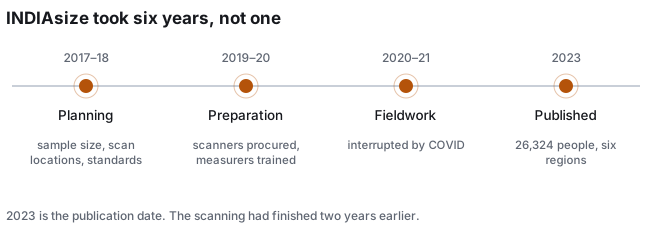
INDIAsize ran under the Ministry of Textiles. NIFT led it, with CMAI on the technical committee. Planning started in 2017. Fieldwork ran from 2019 into 2021 and was interrupted by COVID. The report was published in 2023. So if you've seen 2023 given as the start date, that was the finish.
NIFT's launch of the project was covered in the national press:
What they actually measured#
26,324 people, aged 15 and over, were scanned with 3D whole-body scanners. Not measured by hand. The sample matched census data for age, gender, region, income and community.
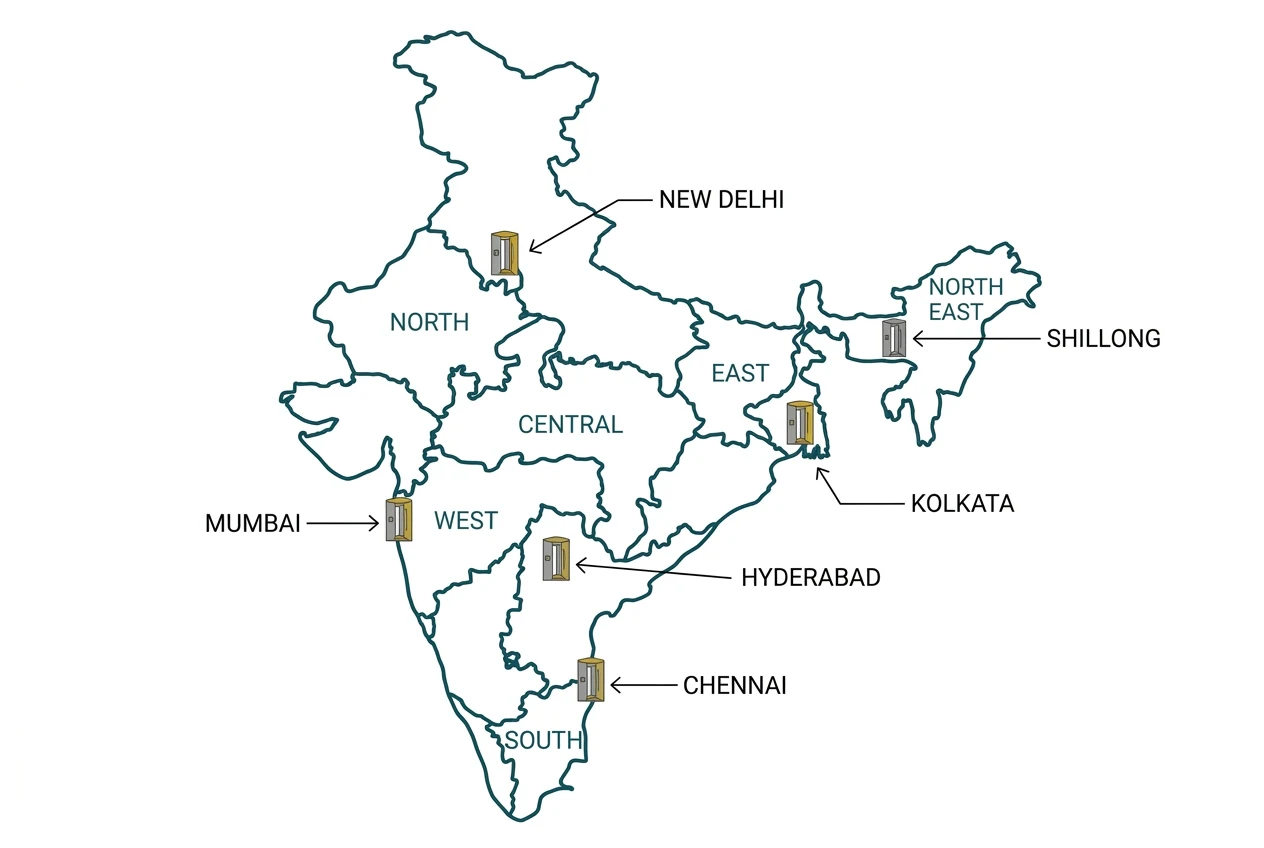
India was divided into six regions, with collection in one major city each. New Delhi for the north. Mumbai for the west. Chennai for the south. Hyderabad for central, Kolkata for the east, and Shillong for the north east.
The national averages it produced#
| All values in cm | Stature | Bust / chest | Waist | Hip |
|---|---|---|---|---|
| Female, national | 151.76 | 93.36 | 83.53 | 98.24 |
| Male, national | 165.50 | 96.03 | 87.57 | 94.62 |
Regional spread inside those numbers is wider than people assume. Female stature runs from 149.13 in the north east to 153.24 in the south. Male chest girth runs from 91.39 in the north east to 97.79 in the south. A single national average is already a compromise before anyone cuts anything.
The comparison that matters#
NIFT put the Indian average next to the exact Western sizes Indian brands were borrowing. That's ASTM's US chart, and W. Aldrich's UK/EU drafting figures.
Female#
| Measurement (cm) | Indian average | ASTM US, size 10 | UK/EU, size 14–16 |
|---|---|---|---|
| Bust girth | 95 | 94.62 | 94.5 |
| Waist girth | 85.4 | 75.56 | 74.5 |
| Bust minus waist | 9.6 | 19.06 | 20 |
| Hip girth | 100.6 | 101.28 | 99.5 |
| Across shoulder | 37.3 | 39.69 | 38.5 |
| Arm length | 52.1 | 58.42 | 59.25 |
| Stature | 152 | 166.37 | 165 |
Male#
| Measurement (cm) | Indian average | ASTM US, 40 regular | UK/EU, size 40 |
|---|---|---|---|
| Chest girth | 101 | 101.6 | 100 |
| Waist girth | 89.5 | 87.63 | 86 |
| Hip girth | 97.6 | 100.33 | 104 |
| Across shoulder | 42.7 | 45.09 | 47.2 |
| Arm length | 57.2 | 61.6 | 65.4 |
| Stature | 166 | 177.8 | 174 |
Look at the first row of each table. The bust matches. The chest matches. NIFT calls it the control dimension. It's the one the size label gets chosen on.
Everything under it is different. The bust-to-waist drop falls from about twentycm to under ten. The shoulder is narrower. The arm is sixcm shorter in the female comparison. Four in the male. At the same chest, the Indian male average is elevencm shorter than the American average the chart was cut for.
So the garment gets picked on the one measurement that agrees. Then it's cut everywhere else for a body shaped differently. That's the whole fit problem. The returns figure is what it costs.
What came out of it#
NIFT grouped people by height and body shape: bust and hip for women, chest and waist for men. That gave three height groups and five body shapes for each.
| Size charts | Size variations | Population covered | |
|---|---|---|---|
| Female | 14 | 122 | 85% |
| Male | 13 | 128 | 87% |
Then the interesting part: NIFT proposed dropping arbitrary labels entirely.
| US label | 6 | 8 | 10 | 12 | 14 |
|---|---|---|---|---|---|
| UK label | 10 | 12 | 14 | 16 | 18 |
| IN label | 85 | 89 | 93 | 97 | 101 |
The US and UK numbers, in NIFT's phrasing, "do not collaborate with any body dimension". The IN column is the bust girth incm. It's the only one of the three you could check with a tape measure.
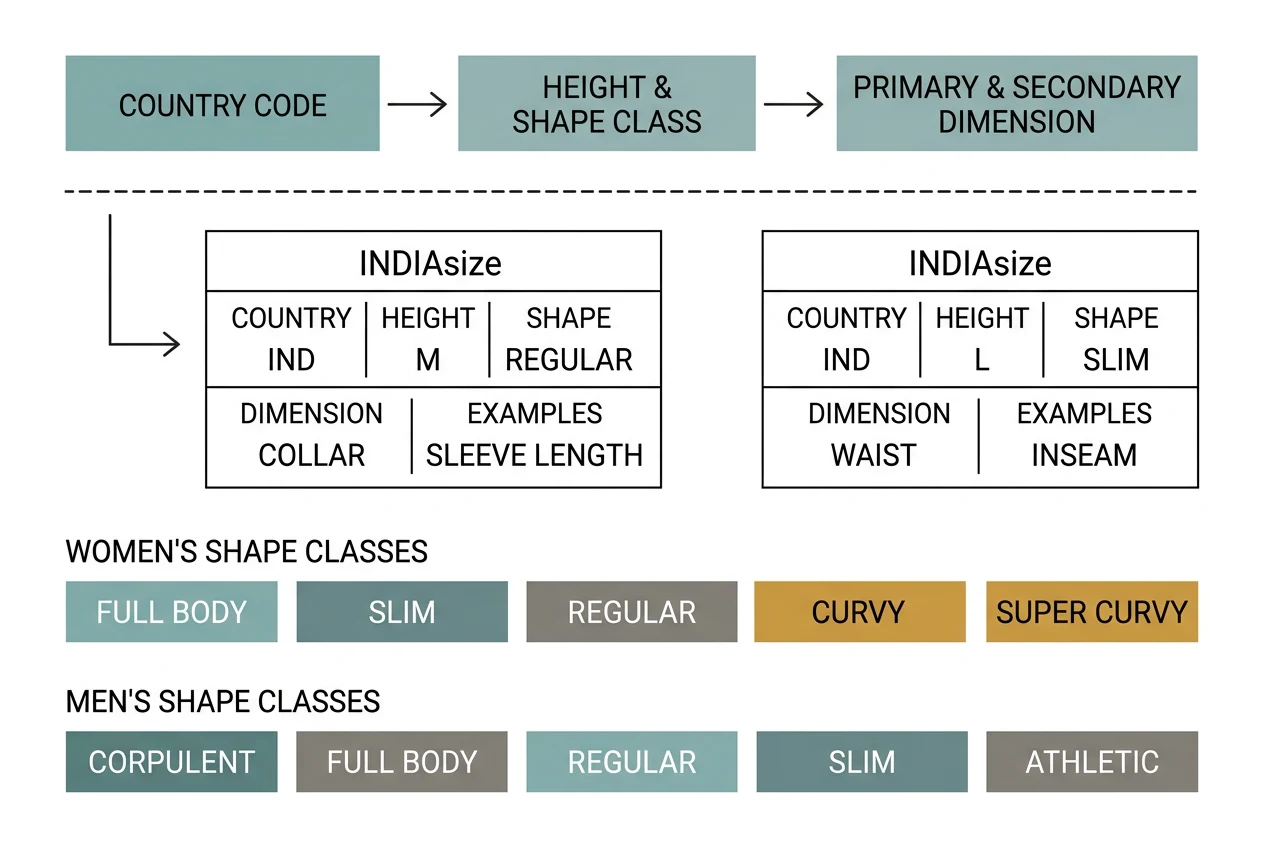
NIFT's full proposal goes further. A country code, then a height and shape class. Then the actual primary and secondary dimensions for that garment: collar and sleeve length on a shirt, waist and inseam on trousers. Shapes are named rather than numbered. Women get Full Body, Slim, Regular, Curvy and Super Curvy. Men get Corpulent, Full Body, Regular, Slim and Athletic. Each one is defined by a stated centimetre difference, not a marketing word.
Whether any of it reaches a tag#
This is where the enthusiasm should stop. The report is explicit that putting the indicator on clothing tags "remains at the discretion of individual retailers". INDIAsize is a recommendation, not a regulation. Nothing forces a brand to grade to it. Nothing punishes one that doesn't.
Which means the practical situation hasn't changed yet. There is still no enforced Indian standard, and every brand's chart is still its own.
What it would mean above 4XL#
Those size charts cover three height groups against five body shapes. That's a serious improvement on one linear grade. But the grouping was built to cover 85% and 87% of the population. The plus-size end isn't where most of that coverage sits.
What would matter most up here is the shape class. A 6XL cut for Full Body and a 6XL cut for Athletic are different garments. Today they carry the same label. Depth through the body and armhole are exactly what a linear grade gets wrong. It's exactly what a shape class would fix. Whether any brand above 4XL adopts it is a different question. Given that most of them don't publish a size chart at all, the honest answer is: not soon.
Sources and caveats#
All figures are from INDIAsize: National Sizing Survey of India, National Institute of Fashion Technology, published 2023. That covers sample size, regional coverage, the national averages, the Western comparison tables, the cluster counts and the label proposal.
Three caveats worth stating. The comparison tables put the Indian average against one selected size from each Western standard. Not against those standards as a whole. An average is not a person, and the regional spread above shows how much it flattens. And the survey covered ages 15 and over from six cities. That's a stratified sample of a very large country, not a census of it.